
Author: Tomfon Ngangyet
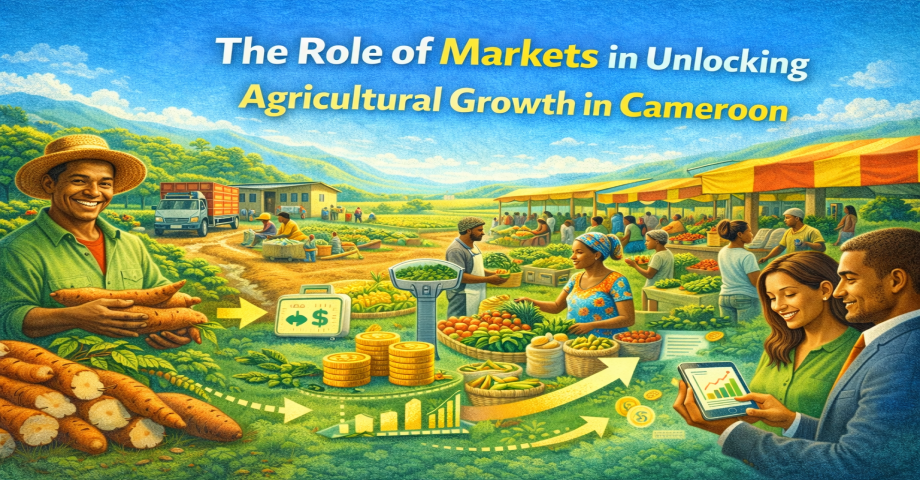
Agriculture remains the backbone of Cameroon’s economy, employing a large share of the population and sustaining rural livelihoods across the country. Yet for decades, agricultural growth has been constrained not by lack of production, but by weak market systems. In Cameroon, markets are the missing link between the hard work of farmers and the prosperity of rural and national economies.
Unlocking agricultural growth requires more than seeds and soil—it requires functional, accessible, and transparent markets.
Farming becomes growth-oriented only when farmers can reliably sell what they produce. Markets provide:
Price signals that guide what and how much to produce
Income opportunities that motivate investment in farming
Demand certainty that reduces risk for smallholders
Without markets, agriculture remains subsistence-based. With strong markets, agriculture becomes a business.
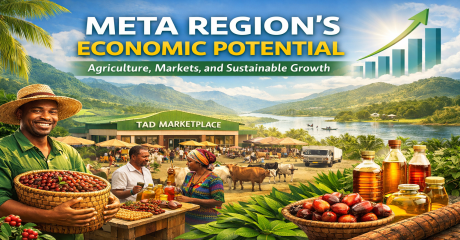
Village and community markets are not merely trading spaces—they are economic anchors. They:
Connect farmers to traders and consumers
Create jobs for transporters, processors, and retailers
Circulate money within rural communities
When local markets are vibrant, rural economies grow organically. When they are weak or inaccessible, poverty deepens even in fertile regions.
One of the greatest challenges facing Cameroonian farmers is post-harvest loss. Poor access to markets leads to:
Spoilage of perishable goods
Forced distress sales at very low prices
Wasted labor and inputs
Improved market access—through roads, storage, and aggregation centers—allows farmers to sell on time and preserve value.
Markets do not only absorb raw produce; they create incentives for value addition:
Processing cassava into garri or flour
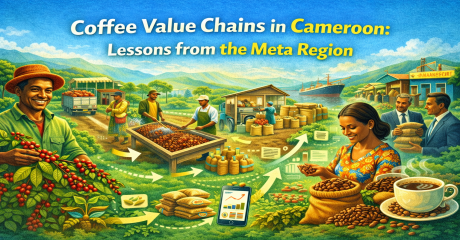
Roasting and packaging coffee
Processing palm fruits into oil
As markets grow, so does demand for processed and packaged products. This creates higher margins, new enterprises, and more resilient agricultural systems.
Weak market systems often leave farmers at the mercy of middlemen. Transparent markets help farmers:
Know prevailing prices
Negotiate fair deals
Plan production more effectively
Digital tools, market information boards, and organized cooperatives strengthen price transparency and restore bargaining power to producers.
Markets cannot function without infrastructure. Agricultural growth depends on:
All-season feeder roads linking farms to markets
Storage and cold-chain facilities
Market sheds and trading centers
Every kilometer of rural road built is not just infrastructure—it is economic opportunity unlocked.
Young people are more likely to engage in agriculture when they see:
Reliable buyers
Profitable value chains
Opportunities beyond farming, such as logistics and processing
Strong markets make agriculture attractive to youth, entrepreneurs, and investors, reversing rural decline and migration pressures.
Cameroon’s strategic location gives it access to regional markets in Central and West Africa. When local markets are organized and standardized:
Farmers can supply larger buyers
Exports become feasible
Agricultural growth scales beyond local demand
Markets are the gateway from local abundance to regional competitiveness.
Agricultural growth in Cameroon will not be unlocked in isolation on farms—it will be unlocked in markets. Markets transform effort into income, production into prosperity, and rural labor into national growth.
Investing in markets is investing in farmers. Strengthening markets is strengthening agriculture. And unlocking markets is unlocking Cameroon’s agricultural future.